sub banner

Your dedicated team of clean energy professionals

Passionate about the environment

Welcome to the heartbeat of Piper Maddox. Meet our extraordinary team of passionate individuals dedicated to driving the clean energy revolution forward.

Alex Cohen
Alex Cohen
Senior Director
Alisha Michaels
Alisha Michaels
Principal Consultant - E-Mobility
Caitlin McCarley
Caitlin McCarley
Manager- UK & Ireland Renewables
Charles Orr
Charles Orr
Divisional Manager – eMobility, Hydrogen & Clean Fuels
Charlie Walker
Charlie Walker
Vice President – Renewables
Charlotte Dungworth
Charlotte Dungworth
Divisional Manager – Client Development & Projects
Desirae Manka
Desirae Manka
Divisional Manager, Commercial Skillsets
Man smiling
Dom Jolly
Manager
Ethan Williams
Principal Consultant
Harjit Singh
Harjit Singh
Division Manager
Headshot of Imogen Simpkin
Imogen Simpkin
Senior Vice President- Commercial Strategy, Client Development & DEI Enthusiast
Jack Massie
Jack Massie
Head of eMobility - Germany, Austria & Switzerland
Jake Calver
Jake Calver
VP – Emobility
Man smiling with short hair
Joshua Snook
Principal Consultant
Kasey Dillon
Kasey Dillon
Divisional Principal
Lacey Collins
Lacey Collins
Divisional Manager – Clean Fuels, Carbon Capture, & Energy Storage
Headshot of Laura
Laura Caswell
Contracts USA - Vice President
Headshot of Liam
Liam Britton-Jeal
Manager – DACH Renewables
Lucy Henry
Lucy Henry
Head of France, Nordics and UK - eMobility (EV charging)
Nolan Cridge
Nolan Cridge
Manager – Renewables
Headshot of Ryan
Ryan Albrighton
Senior Director – Head of Embedded Solutions
Samantha Keay
Samantha Keay
SVP – Piper Maddox New York
Sam Dobbins
Sam Dobbins
Principal Consultant - Clean Fuels
Headshot of Steve
Steve Earl
Director - Market Strategy & Innovation
Sue White
Sue White
Senior Director
Tom Clarke
Tom Clarke
Senior Director

We are proud to be a LHi Group Company

LHi Group, established in 2002, is a global company with four non-competing specialist recruitment brands and a project delivery brand.

Our brands include Lawrence Harvey (Technology), SciPro (Life Sciences), Harper Harrison (Built Environment), XPS (Project Delivery) and of course Piper Maddox (Clean Energy/Tech).

lhi logo

Interested in joining the Piper Maddox team?

Picture yourself at the forefront of the renewable energy revolution, surrounded by a team of passionate professionals who are as vibrant as the green initiatives we support. At Piper Maddox, you'd be part of a community that's reshaping the future, one role or project at a time.

circle 3
circle 4

We are trusted clean energy
recruitment experts.

18 Sept 2026
nuclear power
18 Sept 2026
Your next move should give you more: Building a career at Piper Maddox

Making a career move when things are already going well can be a difficult decision. You’ve built your experience, developed a network and found a way of working that delivers results. The question then becomes whether staying comfortable is still helping you grow. That was something Manny Osaba found himself thinking about before joining Piper Maddox. He already had a strong foundation in recruitment and was performing consistently. What he wanted next was the chance to learn a different way of doing the job, have more influence with his clients and build a reputation of his own within a specialist market. Since joining Piper Maddox, Manny has launched our technology vertical within nuclear energy, built a team around the market and is approaching his second promotion within 18 months. As we continue to hire experienced and senior recruiters into Piper Maddox, we asked Manny about the move, what he was looking for and what the experience has given him so far. What made you consider a move at that stage in your career? "My first business gave me great foundational training to become a good recruiter and find consistent success. I just had this feeling that I would never be able to see if there were any different ways about doing the job if I stayed there forever. I didn’t want to restrict myself to learning from just one company when there could be other ways of going about client development, candidate development etc. I wanted to take a step to join an established, proven player but at a business where I wasn’t going to get lost amongst 100s or thousands of people either." What were you looking for from your next company? "I wanted to feel like I had more influence in the ultimate success of what my clients were trying to do vs. just being one of 1000s of other agencies. I wanted to be seen as an expert for what I did. I wanted to join a business where I could really make a name for myself in the space. I wanted the business I joined to have a great reputation in the market." Why did Piper Maddox stand out to you? "Having employee ownership is fantastic. The general tone of the business is really well balanced between being like a highly professionalized consultancy with specialist recruitment networks and also a reasonable/easy-going place to work." What have you been able to build or take ownership of since joining? "I was the first person in Piper Maddox to launch our technology vertical around our nuclear energy offerings. I started as a C3 and am approaching my second promotion within 18 months of being in the business. I now have a team of 3 who support nuclear with me and have brought several project retainers/subscription services/and embedded projects into the business." What has changed most in your career since making the move? "My clients really count on my input for what is realistic/achievable in terms of their goals to scale and commercialize their products. I also have developed into a more confident, stronger, and well-rounded person." What would you say to an experienced recruiter who is already doing well where they are? "How do you know you can’t be doing better in one of the hottest markets in recruitment."

08 Jul 2026
renewable energy
podcast
08 Jul 2026
The Future is Clean: Hugh Gilmour on Building a Career in Renewable Energy

The Future is Clean is back, bringing together voices from across the clean energy industry to share insight, experience and perspective on the people, careers and conversations shaping the sector. At Piper Maddox, we work closely with the people and businesses driving the energy transition forward. Through The Future is Clean, we’re continuing those conversations, speaking with industry leaders about their career journeys, the challenges facing the market, and what the future could look like for clean energy. In this episode, Myles Whaley, Senior Recruitment Consultant: Renewable Energy - Northern Europe at Piper Maddox, is joined by Hugh Gilmour, Head of Development UK at Telis Energy, for a Quick-fire Careers conversation. Together, they discuss Hugh’s route into renewable energy, how the industry has developed, the biggest challenges facing the sector right now, and his advice for anyone looking to build a career in renewables. Meet the Guest: Hugh Gilmour Hugh Gilmour is Head of Development UK at Telis Energy, a developer of large-scale renewable energy schemes. Coming from a chartered surveying background, Hugh has built his career across the renewable energy sector, working on some of the UK’s most innovative and ambitious projects. Before joining Telis Energy, he worked with businesses including EDF and Dalcour Maclaren, gaining experience across development, land, infrastructure and large-scale clean energy projects. In this episode, Hugh shares a brilliant perspective on what it takes to build a career in renewable energy, how the sector has changed, and where the industry could be heading next. We hope you enjoy this episode of The Future is Clean. Want to listen to this episode on the go? Check out the links below: 🎧 Listen on Spotify Podcasts here.🍎 Listen on Apple Podcasts here. Learn more about Telis Energy here. For career opportunities, market insight and more, visit: https://www.pipermaddox.com/jobs/ To reach out to the podcast host, contact Myles at m.whaley@pipermaddox.com.

23 Jun 2026
clean fuels
insight
23 Jun 2026
International Women in Engineering Day: Lacey Collins on visibility, role models and clean energy careers

International Women in Engineering Day is an opportunity to recognise the women helping to shape technical industries, but it is also a reminder of the work still needed to make these careers more visible, accessible and sustainable for the next generation. Across clean energy, engineering talent is playing a critical role in delivering the technologies, infrastructure and innovation needed for the energy transition. From renewable fuels and bioenergy to Carbon Capture, Utilisation and Storage (CCUS), the sector depends on people who can solve complex problems and help move emerging technologies forward. But for the industry to keep progressing, it needs a broader range of people, perspectives and leadership styles shaping its future. We spoke to Lacey Collins, Divisional Manager - Renewable Fuels, Bioenergy & CCUS at Piper Maddox, about what drew her to clean energy, the barriers women still face in technical and male-dominated fields, and why representation matters when building long-term careers in the sector. What drew you to work in clean energy, particularly in such a technical and fast-evolving part of the industry? I was drawn to working in clean energy because of the passion shared by everyone in the industry. From my very first conversations with leaders in the space, it was clear that this field is driven by passion, integrity, and hard work From your experience, what are some of the barriers women still face when entering or progressing in engineering-related fields? The main barriers we see for women in male-dominated fields are a lack of representation or role models. It’s difficult for the first woman to pave the path for those behind her. Women also have more trouble as caregivers/parents with the hours, work environments, and inflexibility. Why do you think it’s important to spotlight women working in technical or male-dominated sectors like energy and engineering? When women see others succeeding in these spaces, it helps break down stereotypes and send the message that we all belong. Spotlighting women in industry also brings visibility to the unique perspectives, leadership styles, and innovations women contribute, which are essential for the growth and diversity of thought in any industry. Highlighting these stories helps pave the way for future generations and fosters a more inclusive, balanced workforce What’s one piece of advice you’d give to a woman looking to break into a clean energy or engineering-adjacent career? Find a role model/someone that can understand your position. A role model can help show that success is possible and show the blueprint for navigating any challenges that may come up.

30 Mar 2026
energy efficiency
interview
30 Mar 2026
The Clean Energy Six – Finance Edition: Tamara Bordeaux

The Clean Energy Six, Finance Edition highlights the people working behind the financial and strategic decisions shaping the energy transition. In this series, Skye Shaffer, Associate Recruitment Consultant at Piper Maddox, speaks with professionals across the renewable energy finance ecosystem to explore their career journeys, the projects that have defined them, and the opportunities they see for the future of clean energy. In this edition, we spoke with Tamara Bordeaux, a clean energy finance professional with over nine years of experience spanning financial services and renewable energy. After beginning her career at UBS, Tamara transitioned into the energy sector to pursue work more closely aligned with her passion for combating climate change. She has since built a diverse background across community solar, utility-scale development, and M&A at AES, where she worked on complex transactions and large-scale projects across the U.S. More recently, she expanded her experience into emerging technologies at Blue Energy, where she was part of the commercial team at a nuclear-focused startup, working across origination, development, and financial modeling. Now at Greenvolt Power, Tamara continues to focus on project finance and M&A, bringing a well-rounded perspective across both established and next-generation energy solutions. 1. When did you start your career in renewable energy or clean tech, and why did you get into the industry? I started my career in renewable energy in January 2021. Before that, I was working in wealth management and financial services, but I wanted to pivot into something more aligned with my interests and passions - specifically, fighting climate change. The energy industry offered a strong intersection between finance and impact, and it felt like a space where I could apply my background while contributing to something meaningful. 2. What was a pivotal moment or project that defined your path in this industry? A pivotal moment for me was working on the Belfield project, which at the time was the largest permitted solar and storage project in the U.S., at around 2 gigawatts. AES acquired it from Avantus, and I had the opportunity to work on the transaction as an associate. It was a very large, complex, and long-running deal, and it really opened my eyes to how intricate the M&A side of the renewable energy industry can be. What stood out most was the collaborative nature of the process - working closely with counterparties to solve problems together. It was also the first time I was able to build meaningful relationships with a counterparty, and it showed me how important those relationships are in getting deals done. That combination of complexity, collaboration, and relationship-building really defined my path and interest in this space. 3. What excites you most about working in renewables or clean tech today? There is a very real and growing need for power - especially zero-carbon power - in both the U.S. and globally. Renewables are one of the fastest and most proven ways to reduce carbon emissions and fight climate change, so it’s an incredibly impactful space to be in. There’s also a significant increase in demand for power driven by technological growth, including AI. What’s unique right now is that we’re still building the physical infrastructure needed to support that demand, while also benefiting from advancements in AI and software ourselves. For example, AI is helping enhance financial modeling and improve efficiency in areas like transaction document review. It feels like we’re in a position where we get the best of both worlds - building critical infrastructure while leveraging cutting-edge tools. 4. What’s the biggest challenge you’ve faced in renewable energy and what did you learn from it? One of the biggest challenges I faced was transitioning from traditional renewables - primarily solar and storage - into nuclear, specifically the small modular reactor (SMR) space. While there were transferable skills, nuclear presents a very different set of challenges. In solar and storage, processes are well established and costs continue to come down. With nuclear, particularly new nuclear development, it’s more like rebuilding an industry from the ground up in the U.S. There are challenges around developing supply chains, advancing new technologies, and working on much longer timelines - often into the 2030s. It also requires navigating significant policy and regulatory dependencies. This experience pushed me to think more long-term, approach problems more creatively, and become comfortable working in areas with less precedent. It was both challenging and incredibly rewarding. 5. Looking 5–10 years ahead, where do you see the biggest opportunities for growth in renewable energy? One of the biggest opportunities is improving transmission infrastructure and the interconnection process in the U.S. Upgrading the grid will be critical to enabling more projects to come online efficiently. I also see strong potential in co-located solutions - bringing power generation closer to where it’s consumed, such as near data centers. As demand for energy continues to rise, proximity to load will become increasingly important. Overall, I don’t think it’s about one technology winning out - we’ll need a mix of solar, storage, wind, nuclear, and geothermal to meet demand. The real opportunity lies in how we build, connect, and optimize across all of these. 6. If someone wanted to break into renewable energy finance, what’s the one piece of advice you’d give? Be willing to take on any role to get your foot in the door - even if it means taking a step back in title or seniority. That’s what I did, and I have no regrets. Renewable energy is very much a learn-by-doing industry. While coursework and reading are helpful, the most valuable experience comes from working on real projects. I’d also emphasize the importance of networking. It’s a relatively small industry, and people are generally approachable. Building connections can go a long way in opening doors and helping you navigate your career. Tamara’s career reflects the evolving nature of the clean energy landscape - from established renewable technologies to emerging solutions like nuclear. With experience across large-scale transactions, development, and startup environments, she brings a well-rounded perspective on where the industry is today and where it’s headed. As demand for clean, reliable power continues to grow, her insights highlight both the challenges and the significant opportunities ahead.

30 Mar 2026
solar
event
30 Mar 2026
Infocast 2026: Key trends in Renewable Energy Finance & Investment

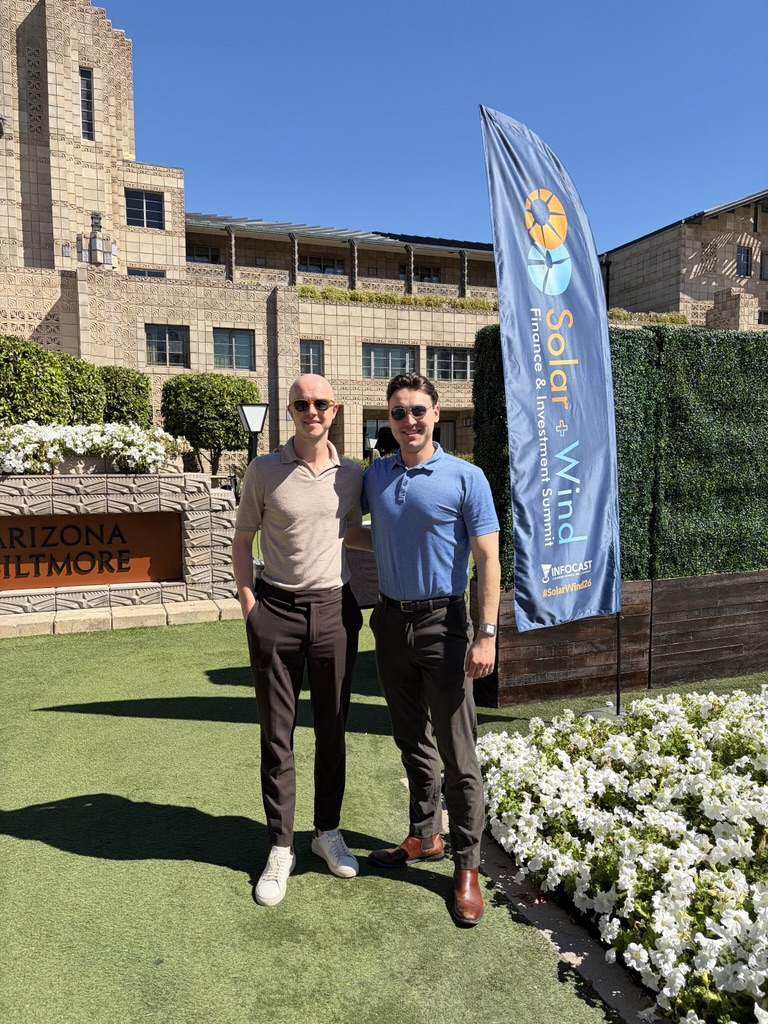
Infocast’s Solar + Wind Finance & Investment Summit once again brought the renewable energy finance community together in Phoenix, Arizona, with conversations spanning deal activity, investment strategy, and the evolving market landscape. Across the week, our consultants Thomas Cooper, Divisional Manager, and Nolan Cridge, Manager, Renewables, connected with clients and industry professionals to understand what’s really happening in the market right now. Here’s what they heard. 1. What were the main finance or investment topics people were talking about around Infocast week this year? The bulk of our conversations with new and existing clients emphasized there is still a tremendous amount of excitement and activity surrounding the renewable space. We are seeing our clients make a very strong push to secure tax equity partnerships for their existing assets, or offload via M&A projects that are earlier stage. Lots of portfolios are growing tremendously through M&A in the solar and storage space as well. 2. From the conversations you had, what are the biggest challenges currently affecting renewable energy project financing? The largest challenge seems to be from within the united states, many foreign countries are hesitant to invest within the united states due to policy changes and an uncertain investment terrain. This year is universally considered more stable, but still gives foreign entities hesitancy to put money back into US markets. 3. What trends are you seeing in the solar, wind or storage investment landscape right now? Overall it seems to continue to be business as usual, just on an accelerated timeline. That said, we had a significant amount of conversations surrounding the integration of AI to all levels of project development, project finance, and M&A transactions. This would likely lead to a downturn in junior level hiring and allow our clients to continue to get leaner. 4. From the people you spoke with, where are investors and developers seeing the biggest opportunities in the market? We are still hearing Solar and Storage as the big winners for the next few years. There are murmurs that Geothermal and Nuclear could be the next renewable assets to be heavily invested in, but there are still a significant number of hurdles to jump through here. 5. Any interesting perspectives or insights from the meetings you had that stood out? The general sentiment around the conference was very positive about the industry as a whole and where opportunity exists. Many of the hiring managers we spoke with express that hiring this year would likely be later in the summer or Q3, and those would be sparce. This year companies seem to be continuing to stay as lean as possible and any hire that is brought on is well thought out, and an extremely high priority. Across the conversations throughout the week, one thing was clear, the renewable energy market remains highly active, with strong momentum across solar, storage, and M&A. At the same time, the landscape is becoming more considered. Investment decisions are more measured, international capital remains cautious around US policy, and businesses are continuing to prioritise lean, high-impact teams. With growing interest in AI and early conversations around geothermal and nuclear, the market is evolving, not slowing. If you’re looking to understand how these trends could impact your team or hiring strategy, get in touch with the Piper Maddox team to continue the conversation.

16 Mar 2026
energy efficiency
interview
16 Mar 2026
The Clean Energy Six – Finance Edition: Samuel Woo

The Clean Energy Six, Finance Edition highlights the people working behind the financial and strategic decisions shaping the energy transition. In this series, Skye Shaffer, Associate Recruitment Consultant at Piper Maddox, speaks with professionals across the renewable energy finance ecosystem to explore their career journeys, the projects that have defined them, and the opportunities they see for the future of clean energy. Our first guest is Samuel Woo, Senior Analyst, Investment Analytics at Cypress Creek Renewables. After serving as a Marine Corps officer overseas, Sam transitioned into renewable energy in 2022. Today, he focuses on evaluating and modelling renewable energy projects, helping ensure that the infrastructure being built today is both economically viable and designed to power homes and businesses for decades to come. When did you start your career in renewable energy or clean tech, and why did you get into the industry? I started my transition to clean energy in 2022. I was a Marine Corps officer at the time and was deployed in Syria in 2021 for about eight months supporting Operation Inherent Resolve, NATO’s mission to counter ISIS in Iraq and Syria. I was operating out of a region known for a lot of oil extraction. The oil industry is a key part of that region’s economy, and seeing the fossil fuel industry up close - seeing the physical consequences of it - had a pivotal impact on me as I was figuring out my next professional steps. At the same time, the Inflation Reduction Act was heavily in the news. Seeing the impact up close and hearing about the momentum happening in clean energy kind of lined up. I wanted to take the skills I learned in the Marine Corps and apply them to energy security, which I thought was really important. Clean energy appealed to me because while every energy source has pros and cons, it wasn’t as pollutant as fossil fuels. So it was a combination of energy security and building something long-term that I felt was a net positive to the world. What was a pivotal moment or project that defined your path in this industry? One pivotal moment was driving through the region in Syria and seeing the pollution related to oil fields - waterways glistening with oil runoff, smoke in the air, fires tied to extraction. That definitely impacted me. From a more recent perspective, I helped model four projects that we bid into an RFP with a major utility, and they were shortlisted. That was exciting because it’s the closest I’ve gotten to getting projects built. Modeling those four projects and getting them close to offtake reaffirmed why I’m in the industry - building long-term sustainable infrastructure that will last decades. What excites you most about working in renewable or clean tech today? It’s knowing I get to play a part in building infrastructure that will last decades - powering homes and businesses. Every project that moves toward COD or offtake is another step toward building resilient, diverse energy systems. As energy demand increases, it’s good to know that part of our infrastructure is based on renewable, clean energy. What is the biggest challenge you’ve faced in the renewable energy space, and what did you learn from it? The biggest challenge was recommending the termination of a project for the first time. A big part of my job is evaluating project-level economics to make sure a project makes financial sense. Terminating a project was tough because we join this industry to build renewable projects - not cancel them. But I learned that we can’t build projects randomly. There has to be strategy behind it. It has to make sense for the customer and for the company. If projects don’t make economic sense, they can raise energy prices or hurt the company long-term, which limits our ability to build more projects. So I learned to understand the macro-level economics of each project and how it impacts the grid. It’s great to build, but we have to build responsibly and feasibly. Looking ahead 5–10 years, where do you see the biggest opportunities for growth in renewable energy? I think it’s finding ways to adapt and meet customer needs. Market signals show we need firm, reliable energy. One solution is long-duration energy storage, and currently battery energy storage systems (BESS). Being creative and innovative to meet market needs is exciting. Long-duration energy storage is the most exciting area for me right now. More broadly, it’s about adapting to emerging technologies and building firm, reliable energy solutions. If someone wanted to break into the space, what is the one piece of advice you would give them? Learn as much as possible about project-level economics. That includes how projects make money - PPAs, offtake contracts, revenue, expenses, capex, and opex. Also understand capital structures because they’re complex and getting more complex. That means understanding tax equity structures, debt structures, and traditional project finance. Understanding revenue drivers, cost structures, tax equity, and debt are the fundamentals of every project. Huge thank you to Sam for taking the time to share his story and perspective. From serving overseas to now working on the financial and strategic side of renewable energy projects, his path is a reminder that this industry is built by people with very different backgrounds, all working toward something long-term. Thoughtful, disciplined development is just as important as ambition in this space, and Sam brings both. We are xcited to see the projects he helps bring to life in the years ahead!